
Replace the spreadsheets
Spreadsheets are fine until the links matter
Everything a compliance spreadsheet cannot do is the part an auditor asks about.
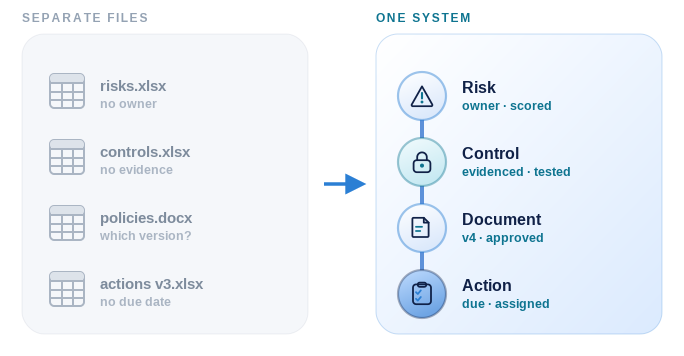
Nothing is wrong with your spreadsheet
Spreadsheets are excellent at what they do. Almost every management system starts in one, and for a single register with a single owner they are often the right answer.
They fail at one specific point: when a record in one file needs to know about a record in another. A risk needs to know its treatment was implemented. A document needs to know who has read it. A finding needs to know whether the action closed.
Spreadsheets cannot hold those relationships, so people hold them instead, in habit, memory and email. That works until the person changes or the business outgrows what one person can carry.
What changes
In spreadsheets and a shared drive
Everything is present. Nothing is connected.
- Registers with no owner, no review date and no reminder
- Two copies of a procedure, and the team using the older one
- Risk treatments with no way to tell whether they happened
- No record of who has read which policy
- Audit readiness reconstructed by hand each time
- Version history that stops at the file name
In a management system
The same information, holding hands.
- Every register has an owner, a review date and a reminder
- One document, version-controlled, with approvals and diffs
- Treatments linked to controls, with owners and due dates
- Mandatory assignments showing who has read what
- A dashboard that answers readiness as a query
- Bulk upload, so you start from what you already have
What a record holds that a cell cannot
The difference is not the storage
A spreadsheet keeps the words. These are the things an auditor asks for that a cell has nowhere to put.
An owner who is a person
Not a department in a column. A named owner the system can chase, and that shows on a dashboard while the work is open.
A review date that acts
A date in a spreadsheet is text. A review date on a record raises a reminder and reports itself as overdue when it passes.
A version, and what changed
Version history with a diff between one and the next, so a reviewer reads only what changed.
Proof it was read
Mandatory assignments record who was asked to read a document and who has completed it. No spreadsheet can answer that question.
Links that hold
A risk points at its treatment, the treatment at a control, the control at the audit that tests it. Break one and the system knows.
A status you can report on
Open, assigned, closed, verified. Reportable across every register at once, which turns readiness into a quick query.
Moving what you already have
The move takes five steps
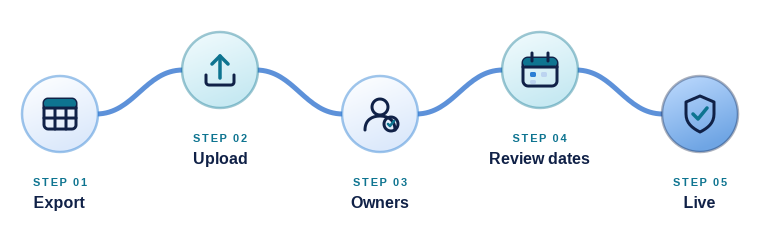
Moving off spreadsheets
- Do we have to retype everything?
- No. Bulk upload takes existing registers, and documents can be imported with an AI-assisted comparison against what the system already holds, so you can see overlap and gaps without re-reading everything.
- What if we only want to move one register to start with?
- That works, and it is a sensible way in. The risk register and document control are the two most people start with, because they are where the missing links hurt most.
- Can we still export to a spreadsheet?
- Yes. There is a downloads area for document and table export, and ten standard reports. The difference is that the spreadsheet becomes an export. The system of record is Objectly.
- Will the team use it?
- That depends on how much of their existing work it replaces. The parts that usually decide it are template packs so the system starts populated, forms so staff can report without a full login, and staff records that do not require a platform seat.
Related
What replaces the spreadsheets
Risk and controls
One register behind quality, environmental, safety and information security risk.
Bring your worst spreadsheet
It is the fastest way to see whether this helps.
No obligation and no credit card required.