
Risk and controls
A risk register that is read more than once a year
Risks, treatments and controls in one register, linked to the objectives, processes and standards they belong to.
The problem with a risk register in a spreadsheet
A risk register in a spreadsheet is a snapshot of one afternoon's thinking. It has scores, it has a heat map, and it has no idea whether anything was done.
The treatment column says "implement access review". Nothing in the file knows whether that happened, who owns it, or which control it became. So the register is rebuilt before each audit from memory and email.
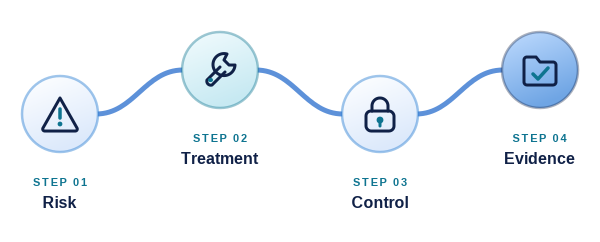
A register earns trust when a risk points at a treatment, a treatment points at a control, and a control points at the requirement it satisfies and the evidence that it works.
How it fits together
Risk, treatment, control
One register, every risk type
Quality, environmental, safety and security risks assessed against the same configurable matrix, so the management review sees one picture.
Treatments with owners
Risk treatments assigned to people and staff, with the accountability recorded on the risk itself, not in the minutes of the meeting where it was agreed.
Controls register
Controls as records in their own right, connecting treatments to the requirements they satisfy and to the audits that test them.
Linked to processes and policies
Risk assessments attach to the processes they concern, and there is AI assistance for drafting risk treatments from a policy.
Security risk and the SoA
Security risk assessment and treatment feed the ISO 27001 Statement of Applicability, so a treatment decision and a control justification are the same record.
Reporting
A risk analysis report, plus risk and CAPA overview on the executive dashboard.
Why one business ends up with several risk registers
Each standard introduces risk in its own vocabulary, and each usually arrives with its own consultant and its own spreadsheet. So the quality register talks about risks and opportunities, the environmental one about aspects and impacts, the safety one about hazards, and the security one about assets and threats.
Underneath they are the same record. Something might go wrong, somebody owns it, something is being done about it, and there is either evidence that it worked or there is not. Keeping them apart means scoring the same supplier four times on four scales, and a management review that cannot add them up.
The same record, five names
What each standard is asking for
ISO 9001: risks and opportunities
Clause 6.1 asks what could stop the quality management system achieving its intended results, recorded against the processes and objectives they threaten.
ISO 14001: aspects and impacts
Environmental aspects with their impacts, kept beside the energy, water, waste, emissions and noise registers that give them their numbers.
ISO 45001: hazards
The hazard register, with chemicals and PPE alongside it, scored on the same matrix as every other risk the business carries.
ISO 27001: information security risk
Assets, threats and treatments feeding the Statement of Applicability, so a treatment decision and an Annex A justification are the same record.
One matrix, one review
Configurable likelihood and impact scales used by all of them, and a single risk analysis report, so a high risk means the same thing everywhere.
Risk register questions
- Do we need a separate register for each standard?
- No, and separate registers are usually where the trouble starts. One register with a shared matrix, filtered by management system, gives each standard its view without anybody maintaining four copies of the same supplier risk.
- Can we configure our own risk matrix?
- Yes. The matrix is configurable in settings, alongside the risk, change control and nonconformance settings.
- Where do opportunities go?
- In the same register. ISO 9001 asks for risks and opportunities together, and treating an opportunity as a separate list is how it stops being reviewed.
- Do security risks and business risks live together?
- They share the register and the matrix, but security risk assessment and treatment also have their own module feeding the ISO 27001 Statement of Applicability, because the SoA needs the treatment reasoning attached to the control.
- Can we import an existing risk register?
- Yes, through bulk upload. It usually pays off, because the value of the register comes from connecting existing risks to treatments and controls. They do not need rewriting.
- How do risks connect to objectives?
- Objectives link to the management systems, stakeholders and change controls that affect them, and risk assessments attach to processes, so the thread from an objective to the risks that threaten it runs through the process that delivers it.
Related
The standards that ask for a risk register
ISO 27001 information security
Annex A, the Statement of Applicability, risks and evidence in one ISMS.
ISO 14001 environment
Environmental aspects, obligations and impacts in a system that keeps them current.
ISO 45001 health & safety
Hazards, chemicals, PPE, inspections and toolbox talks in one health and safety system.
ISO 22301 business continuity
Continuity plans by process, recovery targets, and exercises recorded against them.
See your risks connected
Bring your current register and we will show you what it is missing.
No obligation and no credit card required.